

At the 3rd Carbon Farming Summit event the message was clear: Europe’s carbon farming market is entering a new phase. For the past few years, much of the discussion around carbon farming has focused on methodologies, monitoring systems, certification standards, and policy frameworks. These are all essential building blocks, but for field operators a critical question has always been on top: Who will buy the outcomes?
This challenge was front and centre at the first CRCF Days in Brussels, where the European Commission highlighted the growing momentum behind the new EU Buyers’ Club. The initiative is designed as a voluntary market coordination platform that brings together companies, investors, and public authorities interested in supporting certified carbon removals and carbon farming activities.
The concept may sound simple, but it addresses one of the biggest barriers to scaling carbon farming across Europe. Today, many farmers are interested in adopting regenerative practices that improve soil health, increase resilience, and contribute to climate goals. However, transitioning to new management approaches often requires investment and involves uncertainty. At the same time, companies are looking for credible ways to support climate action within their value chains, and connecting these two sides efficiently has always been difficult.
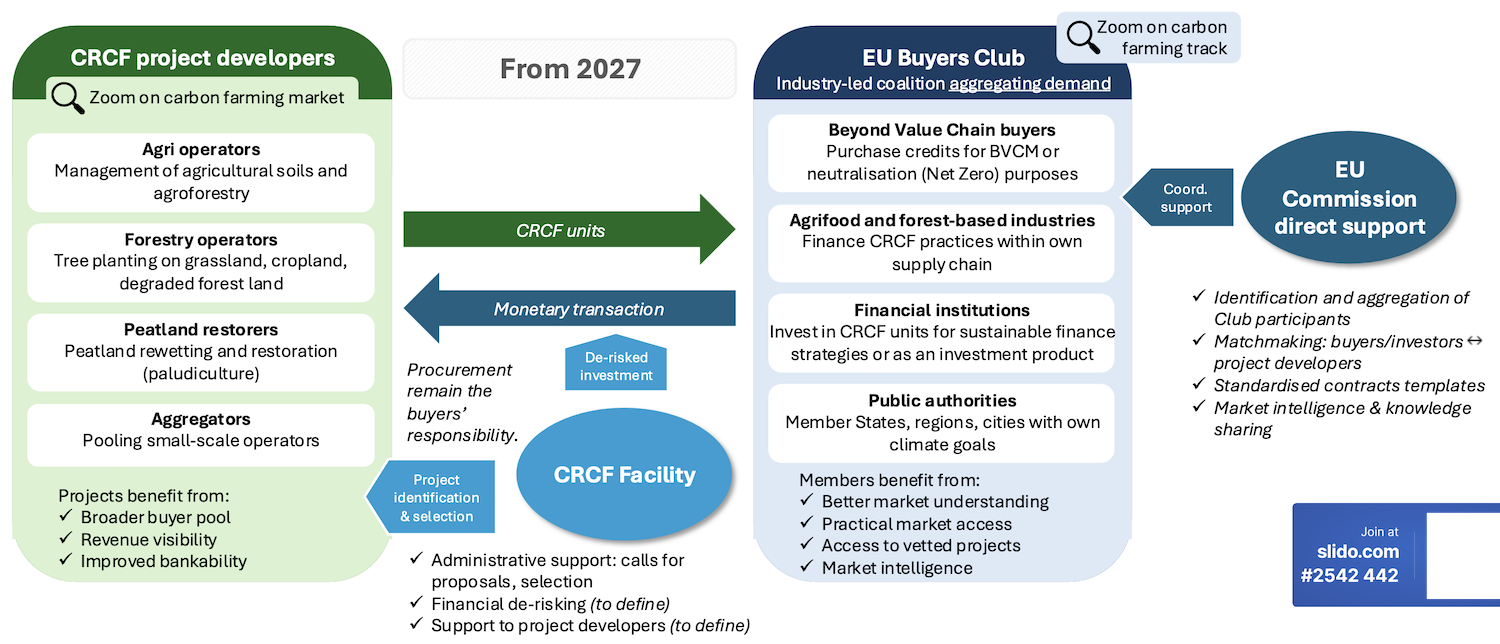
Robust methodologies, reliable monitoring, and transparent verification are necessary. Yet even the most rigorous certification framework cannot succeed if buyers remain hesitant or fragmented. By bringing demand-side actors together, the Buyers’ Club could help create the confidence needed for long-term investment. According to the European Commission, it will help aggregate demand, de-risk investments, and support the transition from pilot projects to large-scale deployment. For farmers, this could mean clearer economic signals and greater certainty that environmental outcomes will be rewarded. For companies, it offers a pathway to support credible climate action within emerging European standards.
The timing is significant. The CRCF Regulation is moving from policy design to implementation. Certification schemes can now apply for Commission recognition, while methodologies for carbon farming activities such as mineral soils, peatland rewetting, and afforestation are approaching adoption.
As the framework matures, attention is shifting from defining the rules to making the market work. Whether the Buyers’ Club ultimately succeeds will depend on participation, transparency, and trust. But its emergence signals an important evolution in Europe’s carbon farming landscape. The conversation is no longer only about how to certify carbon farming outcomes. Increasingly, it is about how to create lasting demand for them. For carbon farming to scale, both sides of the market need to develop together, and in Europe the CRCF Buyers’ Club may become one of the first major attempts to make that happen.