
Carbon farming has moved from pilot projects to implementation over the past few years. Across Europe and the globe, farmers, companies, and policymakers are investing increasing amounts of time and resources into practices that can remove carbon from the atmosphere while improving soil health. But there is a fundamental question that needs to be addressed, and all stakeholders involved should know how to answer to it: how do we know whether the reported carbon removals are actually correct?
The answer can be pretty complex, but a common ground can be found in so called “ground truth”. Ground truth refers to (hopefully) highly accurate, low uncertainty measurements collected directly in the field and used as a reference for validating models, remote sensing products, and monitoring systems. Whether carbon stocks are estimated using soil sampling, Earth Observation data, advanced models, or a combination of all that, reliable reference measurements remain essential.
As carbon farming scales up, the quality of these reference data becomes increasingly important. After all, climate claims are only as trustworthy as the measurements that support them. One common misconception is that more data automatically leads to better results. In reality, data availability and data usability are not the same thing.
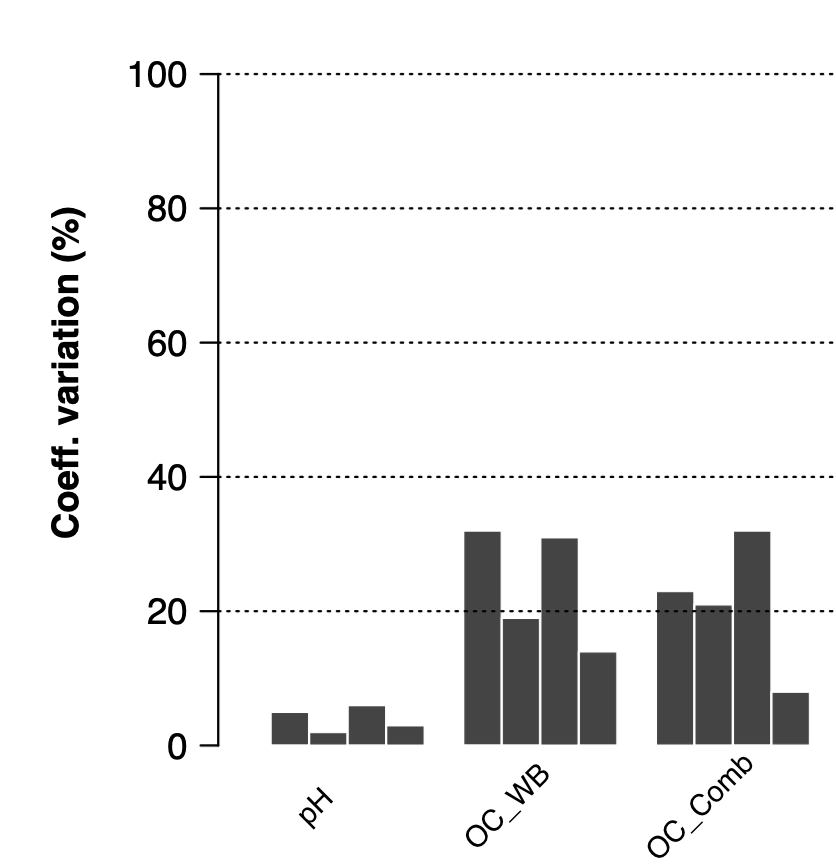
One of the objective of the Global Soil Laboratory Network (GLOSOLAN) established under the framework of FAO Global Soil Partnership (GSP) is to make soil information comparable and interpretable across laboratories, countries and regions. In inter-laboratory comparisons, the same sample is analysed by the different laboratories and results are compared against each other.
https://www.fao.org/global-soil-partnership/glosolan/en/
Soil measurements collected using different protocols, laboratories, sampling depths, or time periods can produce significantly different results. Even when all measurements are technically correct, variations in methods can make datasets difficult to compare or combine. Research has shown that differences between laboratories analysing the same soil samples can be substantial. At the same time, soils are naturally heterogeneous. Two samples collected only a few metres apart may already show noticeable differences in soil organic carbon content. Different pedoclimatic conditions drive highly diverse benchmarks.
This creates a challenge for Monitoring, Reporting, and Verification (MRV) systems. If the uncertainty associated with measurements is not properly quantified, there is a risk that reported changes reflect measurement noise rather than actual changes in soil carbon. In other words, the signal we are trying to detect can be smaller than the uncertainty surrounding it, thus rendering any financing mechanism reliant on carbon quantification unsustainable and not credible.
This, however, does not make carbon farming a “mission impossible”; rather, it means uncertainty must be treated as an integral part of the process rather than an afterthought, and certification protocols devote a lot of efforts towards uncertainty estimation. On top of these assessment, harmonised sampling protocols, transparent benchmarking approaches, continuous quality checks, and robust validation datasets all play an important role in building confidence in carbon farming outcomes.
As Europe develops new frameworks for carbon removals and carbon farming certification, trust will depend not only on the amount of data collected, but also on our ability to understand its limitations and handling them properly.