
For decades, agricultural productivity has been defined in narrow terms: yields per hectare, often sustained by intensive use of synthetic inputs. In the 21st century, this definition is no longer sufficient. We now understand the extensive externalities of conventional farming; its impacts on ecosystems, climate, and ultimately human health. From the loss of freshwater species through eutrophication to the growing evidence linking ecosystem pollution to health issues, the consequences are becoming increasingly visible and urgent. Against this backdrop, the shift toward regenerative agriculture is not simply an option but a necessity. Robust, evidence-based research is therefore essential to support this transition, providing the credibility and urgency needed to accelerate adoption across entire agricultural systems.
The European Alliance for Regenerative Agriculture (EARA) has now entered this discussion with a significant contribution: its Farmer-Led Research on Europe’s Full Productivity, released in June 2025. The study introduces the Regenerating Full Productivity (RFP) index, a multidimensional metric that evaluates farm performance by combining economic outputs with ecological indicators such as photosynthesis, soil cover, and biodiversity.
What sets the EARA study apart is its farmer-led data collection and its integration of economic and ecological performance into a single index. Unlike traditional frameworks such as Total Factor Productivity (TFP), long used in agricultural economics to capture efficiency, RFP goes beyond yields and input ratios. TFP continues to privilege output over ecosystem function and, contrary to earlier expectations, has not been increasing at a pace sufficient to prevent further land expansion (Villora, 2019). The RFP index seeks to rebalance this picture by explicitly including ecological indicators and by involving farmers themselves, the custodians of our landscapes, in the process.
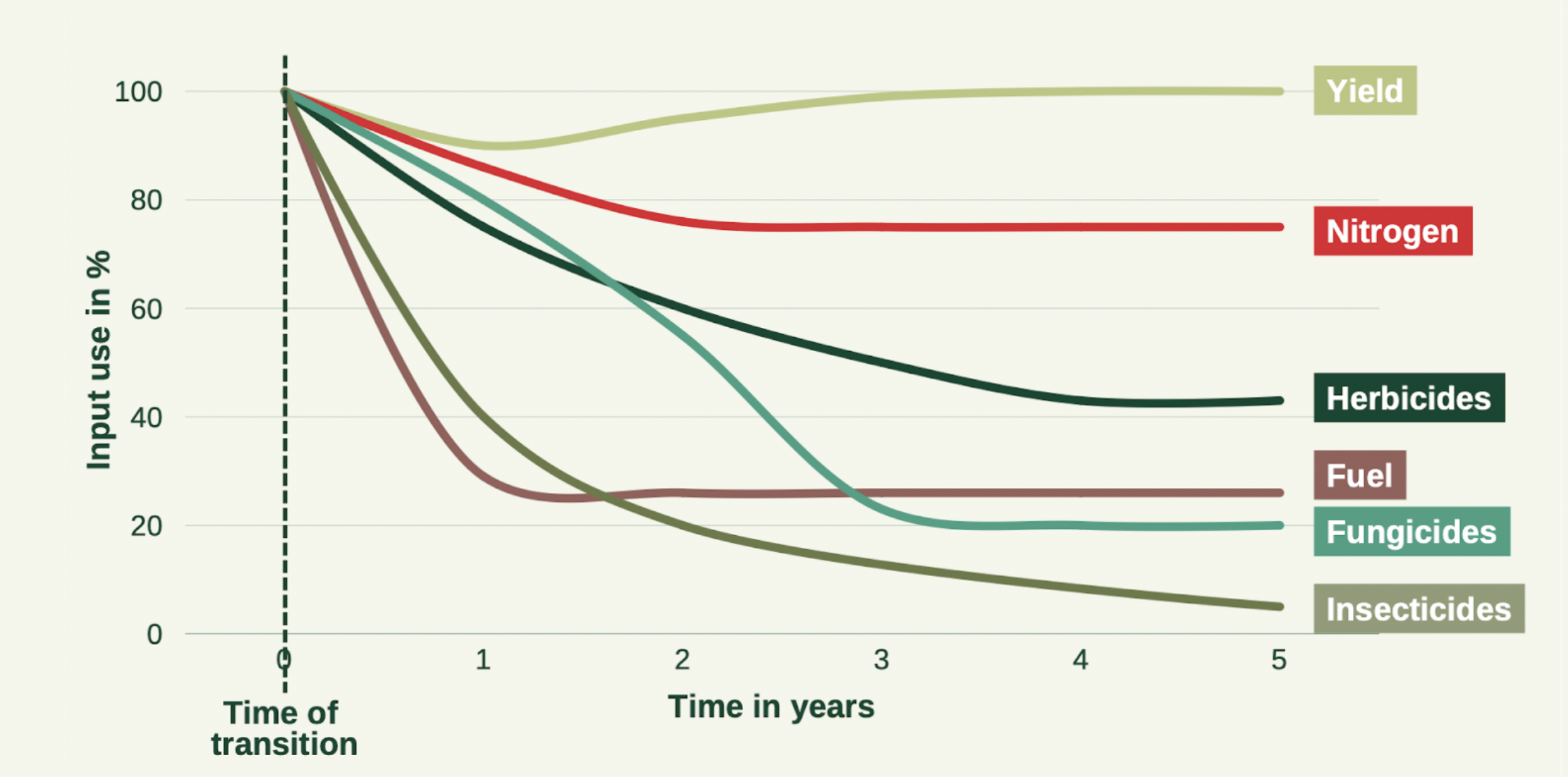
Grounded in data from 78 farms across 14 EU countries, covering over 7,000 hectares, the EARA study represents one of the most comprehensive farmer-led efforts yet to redefine what agricultural productivity means in practice. Its findings highlight the potential of regenerative systems to perform strongly across multiple dimensions. On average, RFP scores were 14–52% higher than conventional benchmarks, with an improvement of roughly 32–33% across the sample. Importantly, these gains were achieved without significant yield losses. Calorie and protein production remained close to conventional levels, while Input use was markedly lower; participating farms reported using 61% less synthetic nitrogen and 75% fewer pesticides. At the same time, ecological indicators showed an average increase of 24–25% in photosynthesis activity, a 23–24% rise in soil cover, and a 16–17% increase in plant biodiversity. Gross margins per hectare were higher, largely due to reduced dependency on costly synthetic inputs, and regenerating farms were significantly more self-sufficient in feed production.
Despite these promising findings, important gaps remain. One central question is whether the RFP results can be replicated across larger and more heterogeneous landscapes, particularly outside Europe. Beyond the field, scaling regenerative agriculture will depend on shifts in consumer behavior, specifically a willingness to pay premiums for produce grown under regenerative standards. This requires not only greater cultural awareness of the benefits of regenerative farming but also supportive policy frameworks. In this context, the Common Agricultural Policy (CAP) could play a more decisive role by shifting subsidies toward regenerative practices, rather than distributing support largely based on farm size. Each year, almost six million farms in the EU receive CAP assistance, yet 80% of these funds flow to just 20% of farms (Europa, 2025), a distribution that risks slowing the transition to more resilient and ecologically sound farming systems.
EARA’s research contributes to a growing body of evidence that agricultural productivity must be redefined to include ecological and social dimensions. By grounding this shift in farmer-led data, the RFP index provides policymakers, businesses, and researchers with a practical tool for evaluating agricultural systems. The report will not resolve the productivity debate on its own, but it does move the conversation forward: from theory and advocacy to field-level evidence. The challenge now is scaling, refining, and integrating these findings into EU policy frameworks such as the CAP, the Soil Health Law, and Farm to Fork strategies.
[…] practices that improve soil health, increase resilience, and contribute to climate goals. However, transitioning to new management approaches often requires investment and involves uncertainty. At the same time, companies are looking for credible ways to support climate action within their […]