
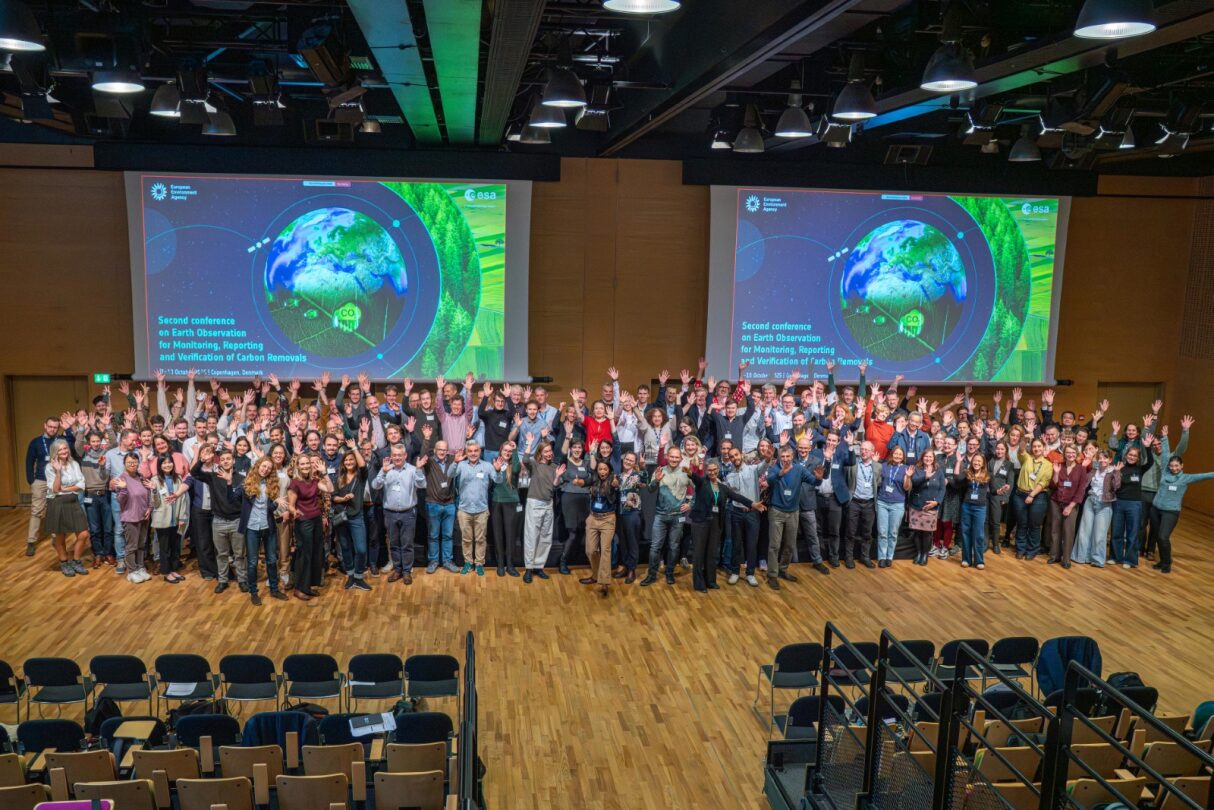
Between October 7th and 9th, more than 200 participants gathered in Copenhagen for the second EEA-ESA conference on “Earth Observation for Monitoring, Reporting and Verification (MRV) of Carbon Removals”, bringing together stakeholders from across the carbon markets, Earth observation, policy making, and certification space. CinSOIL’s CTO Antonella joined a panel discussion on the future of the Carbon Removal Certification Framework (CRCF) and the Voluntary Carbon Market (VCM), exploring the role of Earth Observation in enabling robust, scalable MRV of carbon removals. The panel “The role of EO in enabling robust MRV of carbon removals in voluntary markets” took a deliberately big-picture approach: not just what EO can do technically, but where it sits in the wider value chain of carbon certification, and who ultimately bears the cost of making it work.
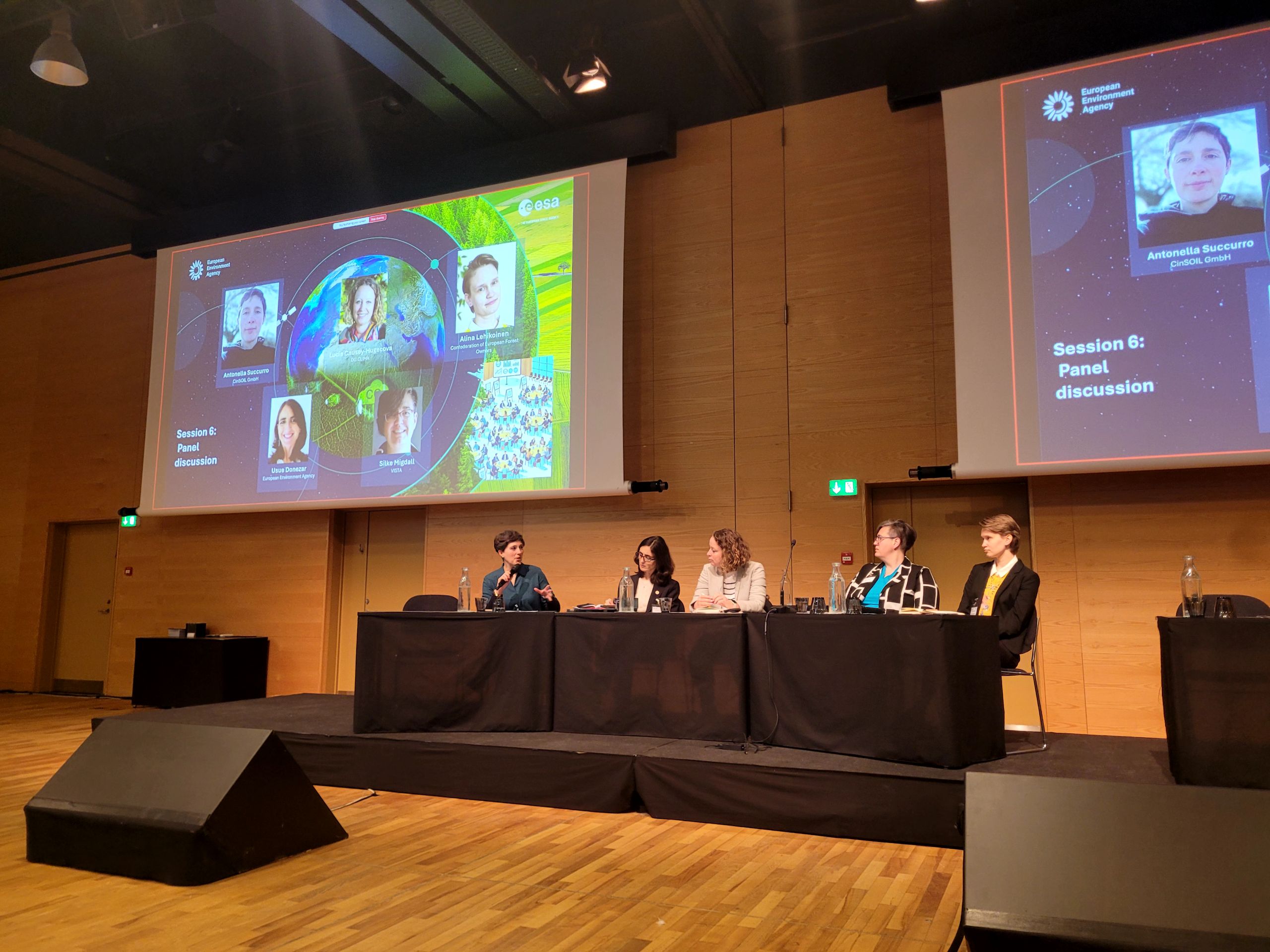
The panel composition represented several stakeholders. From left to right: Antonella Succurro, CinSOIL GmbH; Usue Donezar, European Environment Agency; Lucia Causey-Hugecova, European Commission – DG Clima; Silke Migdall, Vista GmbH; Alina Lehikoinen, Confederation of European Forest Owners.
Three themes anchored Antonella’s contributions to the discussion, driven also by the topics explained in the recommendation paper “Earth Observation (EO) for Monitoring, Reporting, and Verifi cation (MRV) of Carbon Farming (CF) – Uncertainty and Benchmarking” co-authored by her.
On the role of open data. EO technologies offer immense potential for scalable MRV. But EO data alone is not sufficient without good ground-truth data, and the current landscape falls short. A significant share of public research funding flows into projects that generate valuable datasets which then remain inaccessible, or unusable, in contrast to the requirements of the 2023 High-Value Datasets Implementing Regulation. The recommendation paper calls clearly for open data access as a precondition for any credible, interoperable benchmarking system.
On financing and the service provider limbo. One of the panel’s guiding questions was how the service provider sector can contribute to CRCF implementation. Antonella reframed this as a financing problem: who actually pays for high-quality EO-based MRV? This remains genuinely unresolved. The current setup creates an awkward limbo: service providers are expected to deliver rigorous tools, but the business model to sustain them is absent. Public money funds the research; private markets are expected to absorb the products; and the gap in between is where startups like CinSOIL operate every day.
On fair expectations and in-situ data. When asked whether Copernicus public data alone can deliver the accuracy and benchmarking needed for carbon markets, the answer is nuanced: no, not without quality in-situ measurements. Harmonized ground data (soil samples, flux measurements, land parcel information) are the foundation on which any EO-based MRV stack is built. This requires coordinated action at the Member State level, and stronger mandates for data sharing across national inventories. The EU cannot credibly certify carbon removals at scale without it.
Overall, the discussion reflected a field that is maturing rapidly but unevenly: the technical capacity is advancing, the regulatory frameworks are taking shape, yet the data infrastructure and funding models needed to make them work together remain fragmented. The conversations in Copenhagen made clear that the pressure to act is only growing and at CinSOIL we are proud to contribute to the advancement of EO applications for a more sustainable future.