
While the rise of digital farming promises efficiency and innovation, it also raises pressing questions about control, equity, and trust. The EU Code of Conduct for Agricultural Data Sharing (EUCC), introduced in 2018, was co-created by European agri-cooperatives and farmers’ unions to guide the sector through the evolving landscape of data-driven agriculture. Based on principles of data ownership, access, portability, transparency, privacy, and clear liability, its goal is to promote the benefits of data sharing while enabling agri-businesses to confidently enter the era of digitally enhanced farming.
Against this backdrop, the adoption of the EU Data Act in 2024 (set to come into force in September 2025) introduces mandatory data-sharing requirements across industries. Unlike the voluntary EUCC, the Data Act establishes binding obligations, placing pressure on policymakers to evaluate how the EUCC’s principles can inform its implementation. For more on the Data Act’s framework and its implications for agriculture, see our previous post on the EU’s Data Act and the agricultural data space.
A recent study published in Nature Communications analyzed stakeholder perspectives on the EUCC through workshops across Europe. The findings reveal a divergent reception: In the Netherlands, Belgium, and Finland, many farmers and advisors were either unaware of the EUCC or struggled with its legalistic terminology. By contrast, Romanian farmers valued the EUCC as a tool to negotiate better contracts, while French participants demonstrated practical experience and detailed knowledge of its principles.
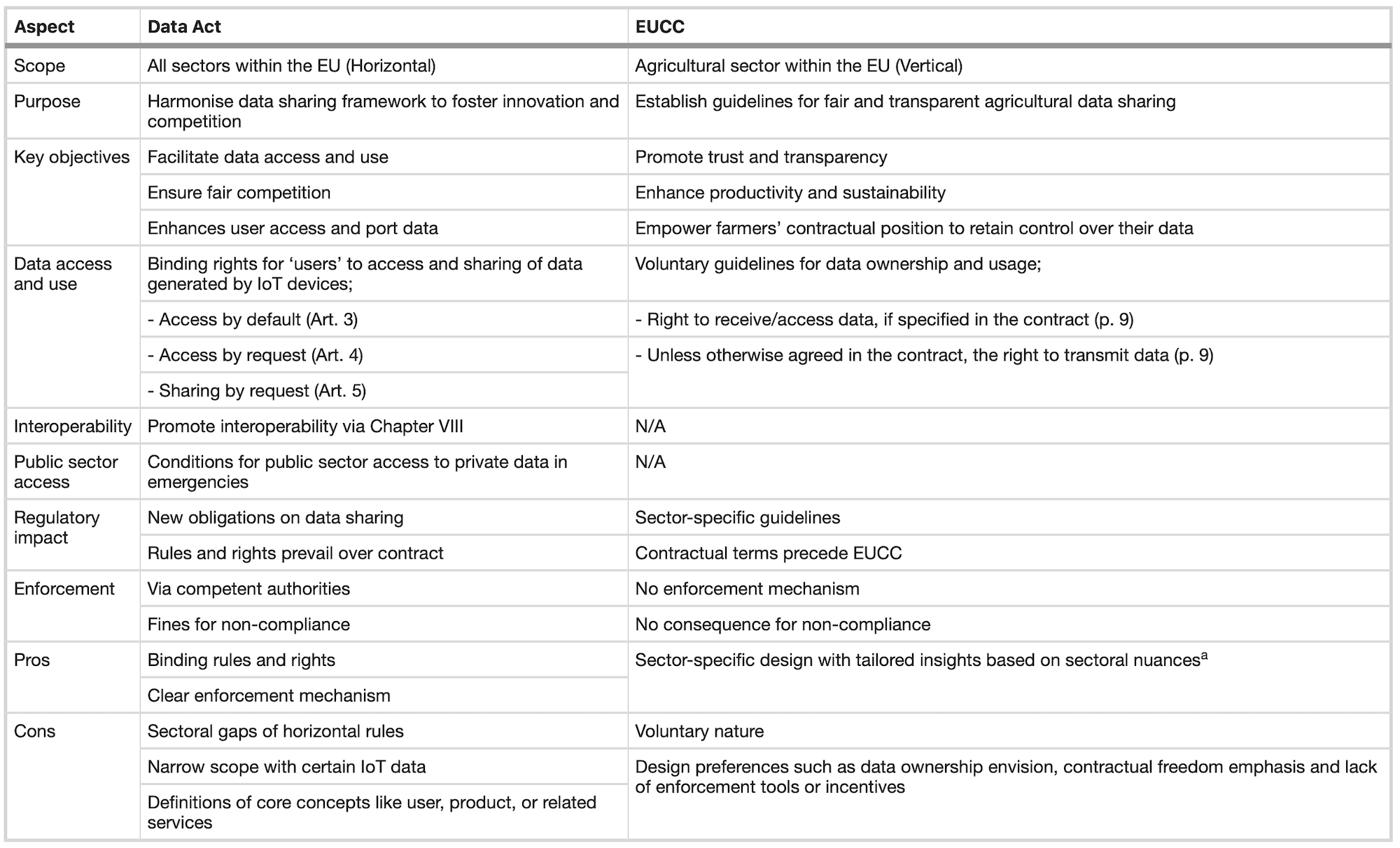
This table highlights the key differences in scope, purpose, and enforcement between the two frameworks, underscoring how the Data Act’s binding rules contrast with the EUCC’s voluntary guidelines.
The future of agricultural data-sharing policy in Europe: stakeholder insights on the EU Code of Conduct.
This discrepancy highlights a critical tension: Can the EU Data Act, despite its mandatory nature, improve uptake and understanding among farmers if the EUCC – formulated collaboratively by agricultural cooperatives – remains poorly understood?
Participants in the workshops discussed in the report consistently emphasized the need for protection in data-sharing, but opinions diverged on what that protection should look like. Finnish farmers found the EUCC’s generic terminology and dense legal phrasing alienating, while EU-level participants warned that heavier legislation could suppress innovation, creating barriers only lawyers and well-resourced entities can navigate.
Launched in April 2025, the Common European Agricultural Data Space (CEADS) aims to create a unified, interoperable framework for agricultural data sharing across the EU. As the Data Act and EUCC continue to shape the landscape, CEADS represents a critical step toward standardizing data access, improving interoperability, and fostering trust among farmers, agri-businesses, and policymakers. For CinSOIL, this initiative aligns with our mission to empower data-driven decision-making in agriculture, ensuring that farmers and stakeholders can leverage shared data to drive sustainability and innovation.
Reference:
Ryan, M., Atik, C., Rijswijk, K. et al. The future of agricultural data-sharing policy in Europe: stakeholder insights on the EU Code of Conduct. Humanit Soc Sci Commun 11, 1197 (2024). https://doi.org/10.1057/s41599-024-03710-1