
The European Scientific Advisory Board on Climate Change (ESABCC) published in February this year the report ‘Scaling up Carbon Dioxide Removals – Recommendations for Navigating Opportunities and Risks in the EU’, highlighting the critical means by which carbon dioxide removal (CDR) potential must be unlocked to achieve net-zero emissions by 2050. The report underscores the need for urgent action to scale up removals alongside emission reductions. Overall, with EU’s natural carbon sinks (forests and soils) deteriorating at an alarming rate due to climate impacts like wildfires and droughts, our ecosystem’s recovery potential shrinks. Hence, policies become crucial to reinforce land-based removals and improve climate resilience in ecosystems.
To build trust, ensure accountability, and drive investments while addressing potential reversals and impacts on ecosystems and communities, the Advisory Board recommends that the EU develop robust monitoring, reporting, and verification (MRV) systems at both activity and national levels (Recommendation 2). Transparency is key to ensuring that removals meaningfully contribute to the EU’s climate objectives; therefore, creating measurable and binding sustainability safeguards within the Carbon Removals and Carbon Farming Certification (CRCF) regulation is crucial to ensuring that carbon sequestration initiatives align with climate adaptation goals.
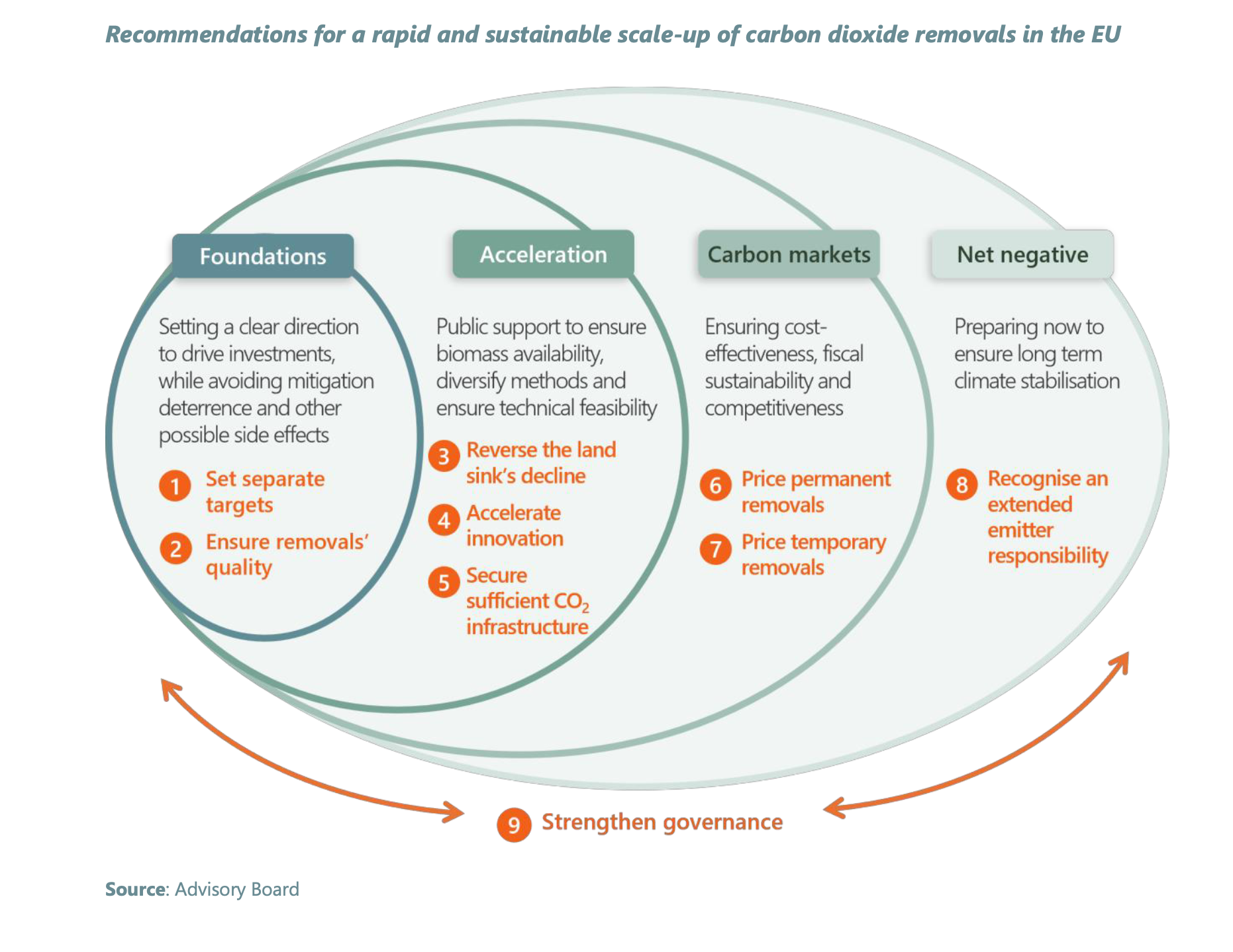
Currently, the EU relies almost solely on its forests and land sector to provide temporary removals. It has set an ambitious target for the land use, land use change, and forestry (LULUCF) sector, aiming for an increase of approximately 15% in net removals compared to the current level. However, the EU’s land carbon sink has declined by around one third over the last decade.
European Scientific Advisory Board on Climate Change, 2025
The ESABCC emphasizes the importance of clearly distinguishing between temporary and permanent removals in CDR certifications. Temporary removals, such as soil carbon sequestration or afforestation, are vulnerable to reversals from land-use changes or climate events. Permanent removals, like BECCS or DACCS, offer long-term storage. The report calls for increased funding, market incentives, and robust monitoring to accelerate CDR adoption. For CinSOIL, this aligns with our mission to measure, report, and verify soil organic carbon, now widely recognised as a key component of land-based removals. By integrating these insights, we can help agri-food companies and carbon market projects build trust and credibility in their climate efforts.